

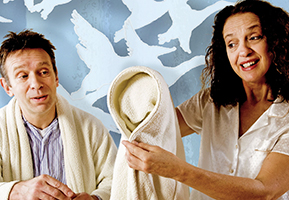
We adapted The Twelve Wild Ducks from a version of the traditional tale told by Geraldine McCaughrean in the Oxford Treasury of Fairy Tales. She titles her version The Thirteenth Child but we have used the title given to the Norwegian version of the tale. There are many variants and you will find a lot of them on the SurLaLune website.
The Thirteenth Child from the Oxford Treasury of Fairy Tales by Geraldine McCaughrean
When the queen had a baby boy, the king was delighted and gave him a silver spoon on a cord to wear round his neck. The queen, too, was happy, thinking the next child might be a girl. When the second was a boy, he too was lovely He too was given a spoon. But the queen did hope her next child would be a girl. Or the next. Or the next. At last, king and queen were blessed with twelve sons—big-boned, bonny boys, bold as bears, each wearing his spoon like a battle medal. The king was hugely happy, but the queen's wish had become a desperate longing.
One winter's day, when the princes were particularly noisy and rough playing snowballs, the queen went, for peace and quiet, to prune her rose garden. A thorn pricked her finger, and blood fell on to the snowy ground. `If only I had a daughter with skin as white as snow and lips as red as blood,' said the queen to herself. A snowball hit her on the back. 'If I had a daughter like that, those boys could fly away, for all I care.'
It was a terrible thing to say—not meant, hardly meant. But the words hung in the air as a frosty smoke, while her blood dripped on the snow. Soon the queen was expecting another child—the thirteenth. And the thirteenth was a daughter.
The baby's first cry pierced the air like a thorn, and in the same instant, all the windows of the palace blew open. At first, the twelve princes thought they had been smothered by an avalanche of snow. Then each looked down and found himself ... transformed: in place of boots, webbed feet, in place of a face, a beak, in place of arms a pair of wings, in place of skin, feathers. All twelve had turned into wild ducks. Through the open window of the palace they flew away—a chevron in the sky, an arrowhead of migrating ducks.
The queen finally had her daughter, and the daughter was as lovely as any rose garden, with blood-red lips and snow-white skin. She too was given her silver spoon. Princess Snow-Rose was a dear, loving child. And yet never a day passed but she felt some dark and terrible sadness haunting the palace, which no one would talk about. She was lonely, too.
`If only I had brothers and sisters to play with,' she began to say one day—and her mother promptly burst into tears! The whole terrible story came out—how her twelve brothers had been turned into wild ducks and had flown away.
`And all because of me,' she whispered, chilling outside and in. I wish that I had never been born. I must go and find them, and save them, even if it costs me my life.'
Nothing the king or queen said could change her mind. She took no purse and she took no carriage, but walked through the world till she was ragged. For three years she walked. One woodland morning, a skein of twelve ducks flurried up into the sky ahead of her. At just the spot where they had taken off, she found a little cottage, and in the cottage twelve chairs round a table, and on the table twelve silver spoons.
I have found them! she thought, dizzy with excitement and hunger. Now all I have to do is wait for them to come home. Porridge was cooking on the stove. She ate a bowlful, using her own silver spoon, then lay down on one of the twelve beds and fell asleep.
With a rattle of wings, the twelve brothers flew home at nightfall. As the last ray of sunlight left the sky, their feathers dropped down in a snowy moult, and they were themselves again—twelve handsome young men (who looked a lot like the king). Sitting down to supper, they picked up their spoons to eat. And there, glittering on the table, lay a thirteenth spoon!
The oldest boy knocked over his chair with a clatter. 'Up and search, brothers! Who can this spoon belong to but our sister—our curse and our sorrow—the cause of all our misery!'
They tore open the cupboards, they overturned the table. They slashed at the curtains and ripped the covers from the beds. But as, at the twelfth bed, brothers and sister came face to face for the first time, and daggers were drawn, the youngest prince raised his voice.
`Stop! Don't kill her! How can she be to blame for what happened to us? She was not three seconds old when the enchantment fell on us.'
Snow-Rose stood up on the bed, her face streaming with tears, her shadow dancing in the lamplight. 'For three years I have searched for you. If killing me will free you from this enchantment, please kill me now. Otherwise, tell me how to lift the spell and I will do it!'
`Impossible,' said the oldest brother. `You couldn't,' said another. `We shall always be ducks by day and men by night.' `No remedy' `What? Weave shirts from nettles?‘ `Weave twelve shirts from nettles ?’ `And not weep?’ `And not speak, all that while?' 'Impossible.' `No. We shall always be as we are,' said the youngest prince.
Snow-Rose said nothing in reply, only nodded her head, unsmiling, dry-eyed. Tomorrow she would begin work. Twelve shirts for twelve ducks. And not a word or a tear or a laugh till the last shirt was made.
Each morning she left the cottage at the same time as her brothers flew off into the cornfields to feed. But Snow-Rose waded, instead, waist-deep into the nettle patch, and gathered up swathes of nettles in her arms.
Like a million hot pinpricks they stung the tender white creases of her arms, her hands, her throat, her face. But she shed not a tear.
Carding, spinning, weaving the nettles into cloth, her poor hands throbbed, livid and red, but she never once cried out in pain.
Watching her, the princes soon saw just how much she loved them, and loved her in return. They begged her but she spoke not one word in reply. For then it would all be for nothing.
Weeks turned to months, months to a year. The nettles were all gone from round the cottage gone throughout the wood. And Snow-Rose had to fetch nettles home miles, in bales on her back. And she worked all day and half the night. Soon all that remained was to sew the woven pieces together. By noon there were only four more shirts to sew By nightfall the princes would have their shirts, and her ordeal and theirs would be over.
Suddenly hoofbeats clamoured through the forest, riders with plumed hats and quivers of yellow arrows. Arrows!
Snow-Rose thought of her brothers winging home over the treetops. She imagined the hunter's arrows piercing them one by one.
Sweeping together her sewing, swinging the bundle over her shoulder, she pelted after the hunters. She could not call out to them, could not shout a warning to her brothers! In the distance, she could hear the whirr of wings, the creaking cry of her brothers singing out to her for their supper ...
As the lead huntsman raised his bow, a ragged girl rushed out of the trees and grabbed his bridle, almost unseating him. His arrow flew wide. The ducks flew by overhead, unhurt.
The king whose aim she had spoiled was only angry for a moment-, he had rarely seen such a pretty girl as the one now standing in front of his horse. He smiled and asked who she was.
Snow-Rose did not answer. `Don't be shy Why did you stop me shooting?' he asked. But Snow-Rose did not answer, could not answer. `Come back to the castle with me, won't you, and tell me all about yourself?'
And Snow-Rose had to go—could not tell him how vital it was to get home, to take the shirts home.
This dumb, ragged, unsmiling beauty intrigued the king, and he soon found himself falling in love with her. It was annoying that she never laughed at his jokes, but something noble and sorrowful spoke to him out of her eyes, so that he was content to sit in silence with her for hours.
But the king's love for Snow-Rose made the ladies of the royal court seethe with jealousy 'Look at her—all spotty red!' they sneered. 'She probably has some disgusting disease!' `She never cries when I pinch her at table.' `Never cries out when I kick her under the table.' `She's probably a witch. Witches never cry' Snow-Rose could not defend herself. When they began to make up lies about her, blame her for everything bad, accuse her of witchcraft and sorcery, Snow-Rose could say nothing in her defense. At last, blood was found on the snow beneath her window, and she was accused of murder. At that, the king's love turned to horror, and he condemned Snow-Rose to death.
`See! See! She doesn't even cry!' jeered the ladies of the court. 'We told you she was a witch!'
As Snow-Rose was led away to a prison cell to await her death at dawn, she made signs that she wanted her bundle of sewing. The prison warder brought it—ooching and ouching—flung it in after her and went away sucking his stinging fingers.
All night Snow-Rose sewed, while outside a bonfire was built of branches and benches and brooms. At the heart of the bonfire was a stake of wood, and round the stake a golden chain. Anyone else would have wept for sheer fear, but Snow-Rose only sewed and stitched, stitched and sewed. Panic swept over her when, at the last moment, she found one sleeve missing: it must have dropped from the bundle as she ran through the woods! Perhaps the magic would fail, for want of that one sleeve. But there was no time to replace it. Morning spilled in at the barred window. The warder's key rattled in the lock.
`Time to die, miss,' he said.
As Snow-Rose walked to the bonfire, she dropped behind her, one by one, twelve coarse and rather odd-smelling green shirts. No sooner did they touch the ground, than wild ducks settled out of the sky, picked them up in their beaks, and flew off with them.
`One last time, I beg you, girl,' said the king. `Speak and defend yourself against this terrible charge!' But Snow-Rose would not speak, could not speak. So they tied her to the stake and lit the fire around her.
Suddenly hoofbeats clamoured over the castle drawbridge, and into the yard rode twelve princes leaning forward in their saddles, shouting themselves hoarse. They came on at the charge, forcing courtiers and ladies to jump aside. 'Let our sister go, or die on our swords!' they yelled. 'She is innocent of any crime but love!'
The fire was doused, the golden chain snapped, and Snow-Rose leapt down from the bonfire to hug all her twelve brothers. 'You're safe! You're saved!' she cried, and her tears of joy intermingled with sobs of laughter.
Now everything could be explained to the king, and the ladies of the court were put to shame for their lying. The blood on the snow, they admitted, had been nothing more than the blood of a pet duck.
With a shudder, the youngest prince held his cloak tight around him and said to Snow-Rose, 'Let's leave this place and go home.' `Yes, but I may return here. I have grown rather fond of the king,' said Snow-Rose, 'and I may well marry him ... But tell me! Did you find the lost sleeve, or was my work enough to recover you all completely?'
`Not completely,' said the youngest brother, and his cloak fell open. In place of his left arm was a duck's wing.
Still, I never heard that he was loved any the less for his strange appearance. Nor, when they returned home to their mother, did she prize her boys any less than her girl—no, not by the breadth of a rose stem, not by the weight of one snowflake.